Explore our network of country and industry based websites to access localized information, product offerings, and business services across our group.
Log in to start sending quotation requests for any product.
Don't have an account? Sign Up Here
Home Potassium Acetate Supply Chain and Global B2B Sourcing
Trade Insights | Supply Chain | 27 August 2026
Potassium Acetate in the Global Chemical Supply Chain
Potassium Acetate Applications Across Key Industries
Food Additive Demand and Regulatory Considerations
Buyer Requirements and Supplier Qualification
Potassium Acetate Logistics and Supply Chain Management
Market Procurement Strategy and Sourcing Risks
Building a Reliable Potassium Acetate Supply Network
Conclusion: Strategic B2B Sourcing of Potassium Acetate
Sources
Potassium acetate is an important potassium salt used across food, chemical, industrial, and processing applications. It is commonly identified by CAS 127-08-2, with the molecular formula C₂H₃KO₂ and molecular weight of approximately 98.14 g/mol. Its broad functionality gives it relevance to buyers looking for a soluble potassium-based chemical with applications extending beyond a single industrial segment.
From a B2B perspective, potassium acetate should be treated as a specification-driven chemical rather than a simple commodity purchase. Buyers may require different documentation, purity expectations, packaging formats, and compliance evidence depending on whether the material is destined for food processing, chemical manufacturing, industrial formulations, or other specialized applications.
The supply chain therefore depends on coordination between manufacturers, exporters, distributors, importers, formulators, and industrial end users. Procurement teams typically need to evaluate product consistency alongside commercial factors such as order quantity, delivery schedule, packaging, documentation, and destination-market requirements.
For international buyers, supplier selection is particularly important because potassium acetate is highly soluble and described in chemical references as a deliquescent crystalline material. These characteristics make appropriate packaging, storage, handling, and transportation planning important elements of dependable supply-chain execution.
Potassium acetate has a diversified industrial profile. PubChem references applications including chemical synthesis, textile processing, antifreeze formulations, pH regulation, industrial de-icing, and other chemical uses. This diversity helps create multiple procurement channels and reduces reliance on a single end-use segment.
Industrial de-icing is another recognized application for potassium acetate. Its use in formulations designed for ice control positions it within a market where buyers can prioritize performance, handling characteristics, supply reliability, and application-specific specifications.
For chemical manufacturers, potassium acetate can also function as a processing material, intermediate, or pH-regulating component. The precise commercial opportunity depends on the technical specification required by the downstream process and the regulatory environment in the destination market.
This application diversity means suppliers serving potassium acetate buyers can support customers across multiple sectors. For procurement teams, however, the correct grade and documentation should always be matched to the intended end use rather than assuming that one specification is appropriate for every application.
Food processing represents an important application area for potassium acetate. The U.S. FDA lists potassium acetate under its Substances Added to Food database, identifying it as a flavoring agent or adjuvant and referencing 21 CFR 172.515.
Codex Alimentarius identifies potassium acetate as INS 261(i), while the Codex functional-class framework recognizes potassium acetate under the potassium acetates group for functions including acidity regulation and preservation.
For food-industry buyers, regulatory status should therefore be considered alongside commercial specifications. Documentation, labeling, applicable food regulations, certificates, and customer-specific quality requirements can all influence supplier qualification and purchasing decisions.
A B2B supplier supporting food processors must understand that food-grade procurement is documentation-intensive. Buyers may evaluate identity, purity, consistency, traceability, certificates of analysis, packaging integrity, and regulatory suitability before approving a material for production use.
Potassium acetate buyers generally need consistent material characteristics that correspond with their manufacturing process. Depending on the application, purchasing specifications may cover purity, physical form, moisture, solution characteristics, packaging, and other parameters defined in the buyer's technical specification or applicable standard.
Documentation can be a decisive part of supplier qualification. Food and industrial buyers may request a certificate of analysis, safety documentation, technical data, origin information, and other compliance records before approving a supplier. The required documentation should be aligned with the intended application and importing-country rules.
Procurement teams also assess whether suppliers can maintain consistent specifications across repeated shipments. A competitive quotation is less valuable when product variability creates production adjustments, quality investigations, or delays in customer approval.
For distributors and chemical traders, supplier qualification should therefore combine technical, regulatory, and commercial evaluation. Establishing clear specifications before purchase helps reduce misunderstandings and creates a stronger foundation for repeat potassium acetate transactions.
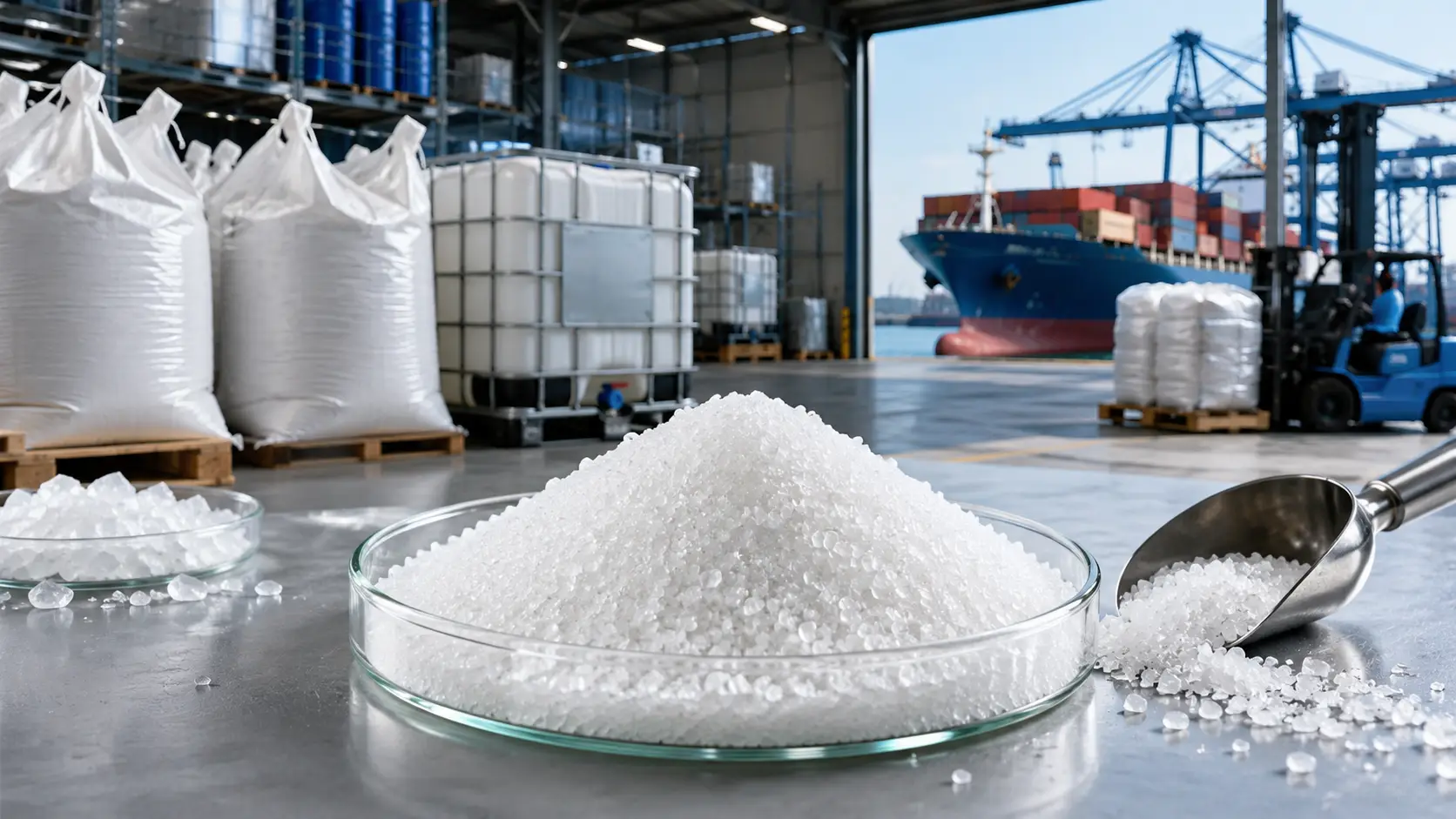
Potassium acetate is described as a white crystalline powder or colorless, deliquescent crystalline material. Its strong water solubility means that moisture management is an important consideration during storage and transportation.
Export shipments require coordination between the supplier, freight forwarder, importer, warehouse, and final customer. Packaging selection should protect the material from environmental exposure while remaining compatible with the buyer's handling and storage system.
Supply-chain planning becomes especially relevant for customers operating continuous production. Procurement teams may therefore establish delivery schedules, safety stock policies, preferred shipment sizes, and backup sourcing arrangements to reduce the impact of transportation delays.
For international B2B trade, logistics performance can ultimately influence the delivered cost of potassium acetate as much as the quoted material price. Freight, insurance, port handling, customs procedures, warehousing, and lead times should all be incorporated into sourcing decisions.
Potassium acetate procurement should not be based solely on the lowest offered price. A lower quotation may become less competitive if inconsistent specifications, documentation gaps, shipment delays, or inadequate packaging increase the customer's total procurement cost.
A structured sourcing strategy can help buyers manage supply interruptions. Procurement teams may compare multiple qualified suppliers, establish realistic lead times, monitor inventory levels, and maintain clear technical specifications for alternative sources.
Market conditions can also affect purchasing decisions through feedstock costs, energy expenses, freight rates, production capacity, exchange rates, and regional demand. Because these variables can change, buyers benefit from periodically reviewing supplier quotations and delivered-cost assumptions rather than relying indefinitely on historical purchasing prices.
For distributors and industrial users, a reliable B2B marketplace can simplify supplier discovery and comparison. The objective is to create a sourcing process that combines competitive commercial terms with quality assurance, regulatory alignment, dependable logistics, and responsive supplier communication.
A dependable potassium acetate supply network begins with qualified suppliers that can demonstrate appropriate product specifications, documentation, production capability, and export experience. Buyers should define their technical and commercial requirements before requesting quotations so suppliers can respond against the same purchasing criteria.
Long-term procurement can improve visibility for businesses that consume potassium acetate regularly. Forecasting demand, establishing preferred specifications, and discussing shipment schedules with suppliers can create greater predictability across purchasing and inventory management.
Supplier relationships also become more valuable when technical and commercial communication is consistent. Clear communication about product grade, packaging, delivery destination, required documents, and expected volumes reduces avoidable errors during international transactions.
For global buyers, Tradeasia International can support the broader sourcing process by connecting chemical demand with international B2B supply capabilities. The emphasis should remain on matching potassium acetate specifications and commercial requirements with an appropriate supply solution.
Potassium acetate occupies a versatile position within the chemical supply chain because of its applications in food-related processing, pH regulation, industrial chemistry, de-icing, and other formulations. Its recognized food-additive status and broad industrial functionality give the product relevance across multiple B2B purchasing channels.
For buyers, successful procurement depends on more than availability. Product specification, documentation, packaging, regulatory suitability, logistics, supplier consistency, and total delivered cost should be evaluated together when selecting a potassium acetate source.
As global chemical trade becomes increasingly specification- and compliance-driven, procurement teams can gain an advantage by developing structured sourcing processes. Comparing qualified suppliers and establishing clear purchasing requirements can improve both supply continuity and commercial control.
Tradeasia International provides a B2B-oriented platform for chemical sourcing, helping buyers explore supply opportunities and connect their requirements with international chemical trade capabilities. For potassium acetate procurement, the strongest sourcing strategy is one that balances product quality, regulatory requirements, reliable logistics, and long-term supplier performance.
We're committed to your privacy. Tradeasia uses the information you provide to us to contact you about our relevant content, products, and services. For more information, check out our privacy policy.


 English
 Indonesian
 简体字
简体字
 العربية
 Español
 Français
 Português
 日本語
日本語
 한국어
한국어
 Tiếng Việt



















